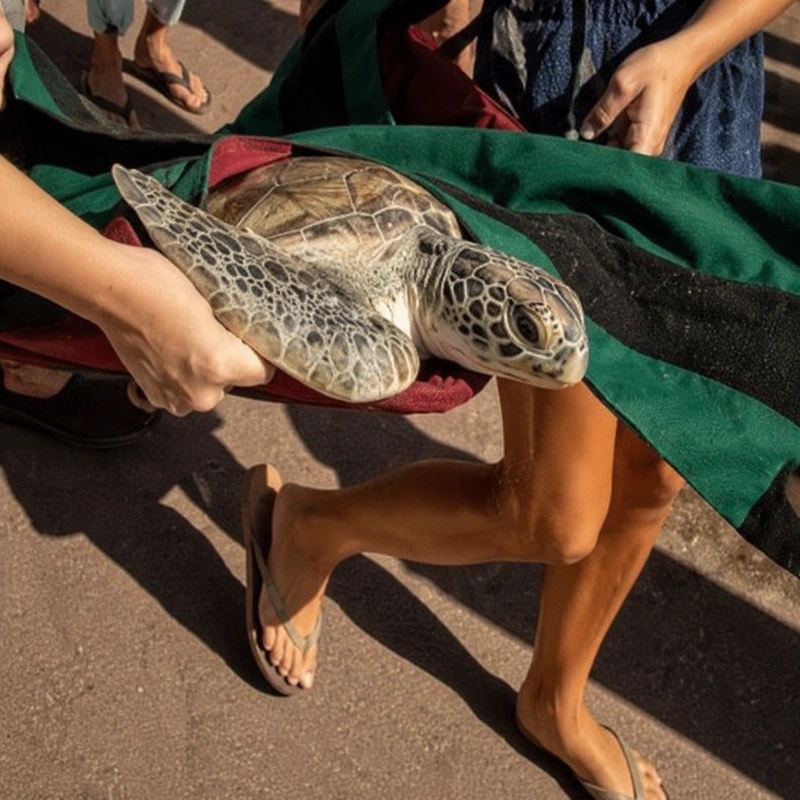
Sunshine Coast leads the world in sea turtle conservation - rescuing 71 turtles in one year
SEA LIFE Sunshine Coast Aquarium has been recognised as a global leader in sea turtle conservation after rescuing more than three quarters of all marine turtles rehabilitated across the international SEA LIFE network in 2025.
The recognition comes in SEA LIFE's 2025 Making Waves for our Oceans Conservation and Wildlife Rehabilitation Report, which highlights the aquarium's extraordinary contribution to protecting Australia's vulnerable marine life.
In 2025 alone, SEA LIFE Sunshine Coast admitted 71 sea turtles into its Turtle Rehabilitation Hospital, including four hatchlings, with 41 successfully returned to the wild after months of specialist veterinary treatment and rehabilitation.
Over the past five years, the aquarium has treated almost 580 sea turtles, successfully returning approximately 442 to Australia's oceans, an overall rehabilitation success rate of 76.5 per cent. The momentum has continued into 2026, with 52 turtles already admitted, including 23 hatchlings, with 14 successfully released back into the wild.
On Saturday, 18 July, as part of the Mooloolaba Beach Clean Up Day, Digger, a Green Sea turtle, was released back into the wild following weeks of specialist rehabilitation.
Digger was initially admitted to Australia Zoo Wildlife hospital on the 23rd of May suffering from a buoyancy disorder known as coelomic floating, before transferring to SEA LIFE Sunshine Coast on the 10th of June to continue his recovery. After responding well to treatment and exceeding his target bodyweight, Digger was fit for release, marking another successful conservation outcome for the aquarium’s Turtle Rehabilitation Hospital.
SarahHarrison, Veterinary Nurse, SEA LIFE Sunshine Coast, said, "Every turtlein our care receives individualised attention, from veterinary assessmentthrough to specialised treatment, rehabilitation and behavioural monitoring."
"Many arrive suffering from devastating injuries, buoyancy disorders, malnutrition or the impacts of marine debris and pollution. Seeing those animals return to the ocean is incredibly rewarding because every successful release strengthens wild populations of these vulnerable species."
The Turtle Rehabilitation Hospital regularly cares for green, loggerhead, hawksbilland the uniquely Australian flatback turtle, with many patients requiring months of intensive rehabilitation before they are healthy enough for release.
The global report highlights the scale of SEA LIFE's conservation efforts, with teams across more than 50 aquariums delivering 104 conservation projects, rescuing 683 marine animals, and contributing more than 34,000 hours to wildlife conservation throughout 2025.
Chris Brown, Director of Conservation, Welfare and Education, Merlin Entertainments, said, "SEA LIFE Sunshine Coast is a shining example of how a passionate local team can make a measurable difference for marine life."
"Their work embodies our mission to Rescue, Restore and Protect our oceans, demonstrating that hands-on conservation, scientific expertise and community engagement can create meaningful outcomes for threatened species."
Beyond rehabilitation, SEA LIFE Sunshine Coast educates thousands of guests each year on the key threats facing marine wildlife, including plastic pollution, fishing line entanglement, habitat loss, and climate change. This work extends into the community through turtle release events, beach clean initiatives and hands-on conservation programs that turn awareness into action along the coastline.


%202.png)
